A Guitar for Matilda
In 2018, I ordered my first custom guitar, a Lakewood. That guitar is a story for another day too, but one thing we did on it was to engrave the name of my second daughter onto the fretboard. However, this meant I only had a guitar named after one daughter, not both. This could not stand. (As excuses go for buying a new guitar, I still think this one holds up well.)
But… which guitar? I wanted to treat myself but the more custom you go, the more options there seem to be. A few years before, I had met Stuart Ryan, who was teaching at Thomas Leeb’s amazing Acoustic Bootcamp in Austria. At the time, he was regularly recording demo videos for The North American Guitar, a dealer for boutique hand-made acoustic guitars in London. So I reached out to Stuart for advice about which guitar to get, since these are the types of guitars you can’t just find in a shop and try. It’s a big investment, so getting it “wrong” — or rather, getting the wrong thing for you — is a big risk. So I explained to Stuart what I was looking for: something midsized, i.e., OM / Grand Auditorium size. Great allrounder. Very responsive. I had an eye on the guitars by luthier Ted Åstrand from Sweden. But Stuart recommended up-and-coming luthier Ryan Gerber. He himself had just purchased one of his guitars and spoke of it in the highest tones.
So I reached out to Ryan. I had never commissioned such a bespoke custom guitar before. It was quite a unique and exciting experience. While the Lakewood was a custom-shop guitar, I had mostly selected the woods and parts myself from available options in a (dangerously addictive) online guitar configurator. But with Ryan, so many more things were possible. It was a bit daunting, to be honest.
I had some specific ideas as to what I wanted from the guitar itself, as well as what I wanted to be represented on the guitar design-wise. At the same time, I am not a particularly visual person, nor a designer. I can’t draw for the life of me, and as an adult I’ve learned that I am rather high (low?) on the aphantasia scale: I think conceptually, not visually. So it can be tough to communicate what it is that I “want” or prefer when, in reality, I can only say so when I see it.
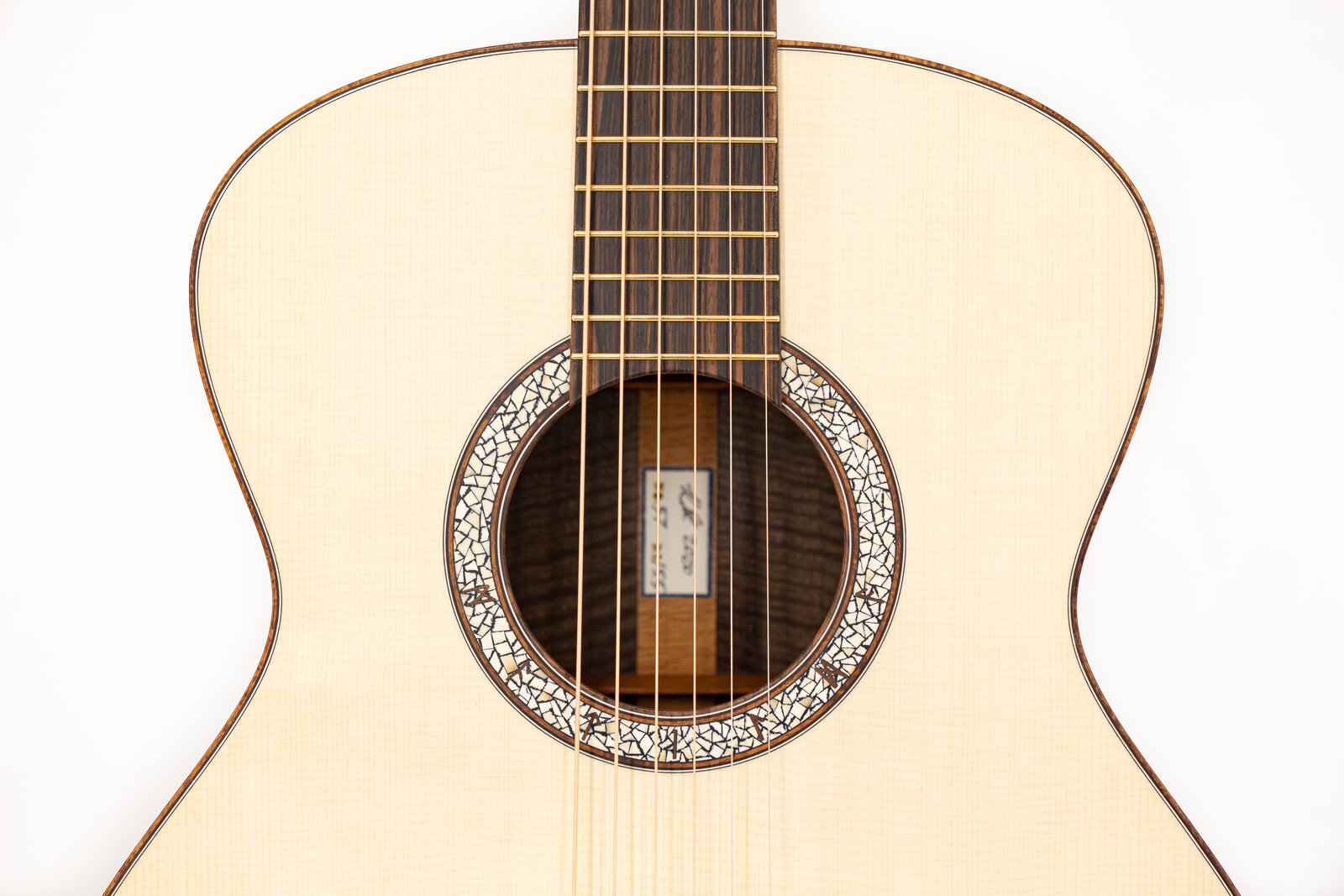
First was the easier part: the instrument itself. I chose Ryan’s RL15.5 model, which is a midsized body, just as I wanted. It’s about-ish the size and volume of an OM-28, albeit somewhat deeper. The wood selection was easy too: beautiful Swiss “moon spruce”1 for the top and Claro walnut for the back and sides. One of the things I was aiming for was to minimize exotic woods, and I love the looks and sounds of walnut guitars. For the fretboard we chose Macassar ebony, but one that is highly figured, not straight black. This is something I’ve come to love since I bought my Taylor 814ce a few years before. I think it gives the guitar a beautiful fingerprint and it preserves precious wood that is not “perfectly” black but perfect in every other way. We also settled on a slightly wider neck width and string spacing to accommodate my big hands better.
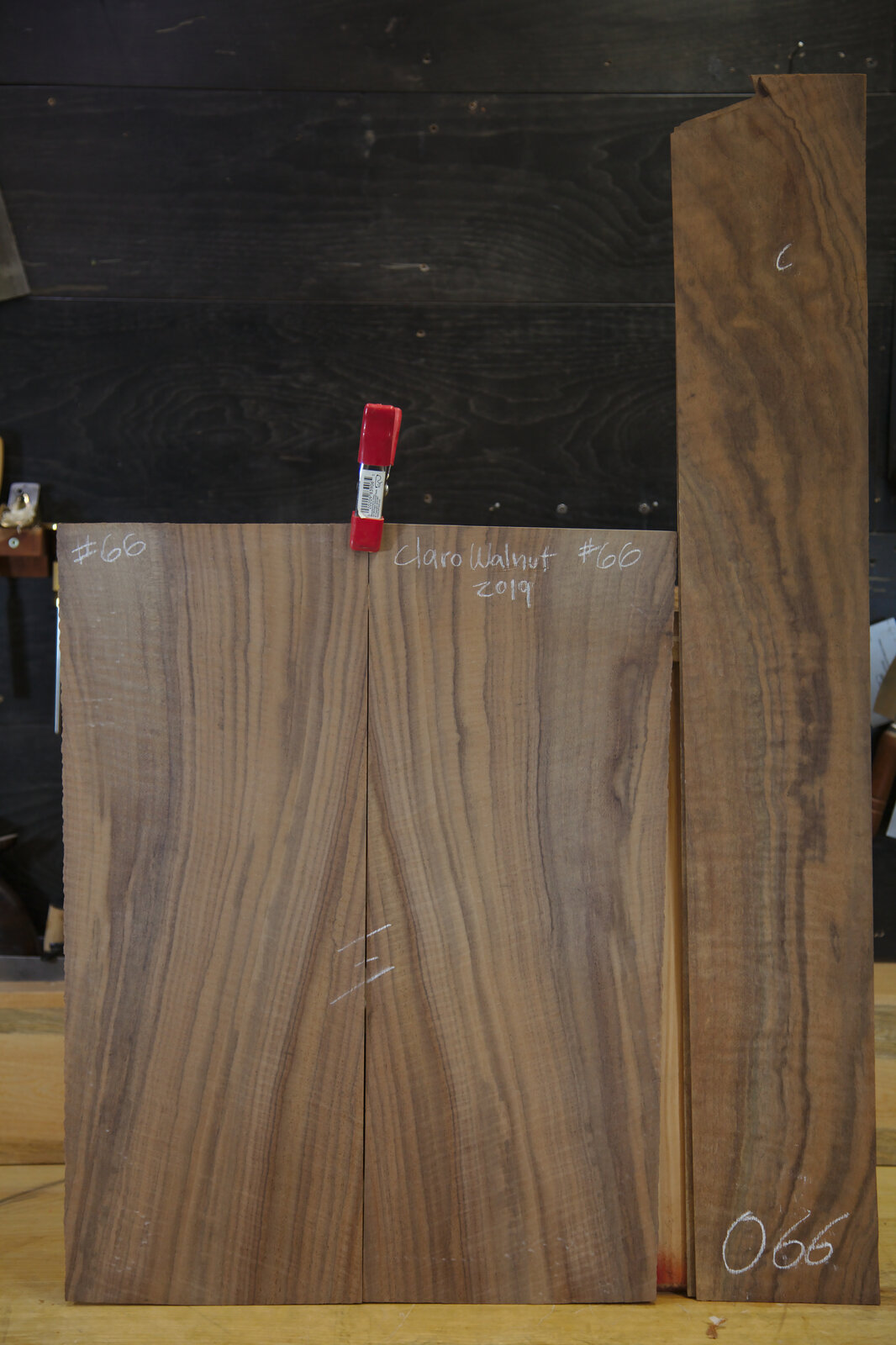 Claro walnut set #66, waiting in Ryan’s workshop…
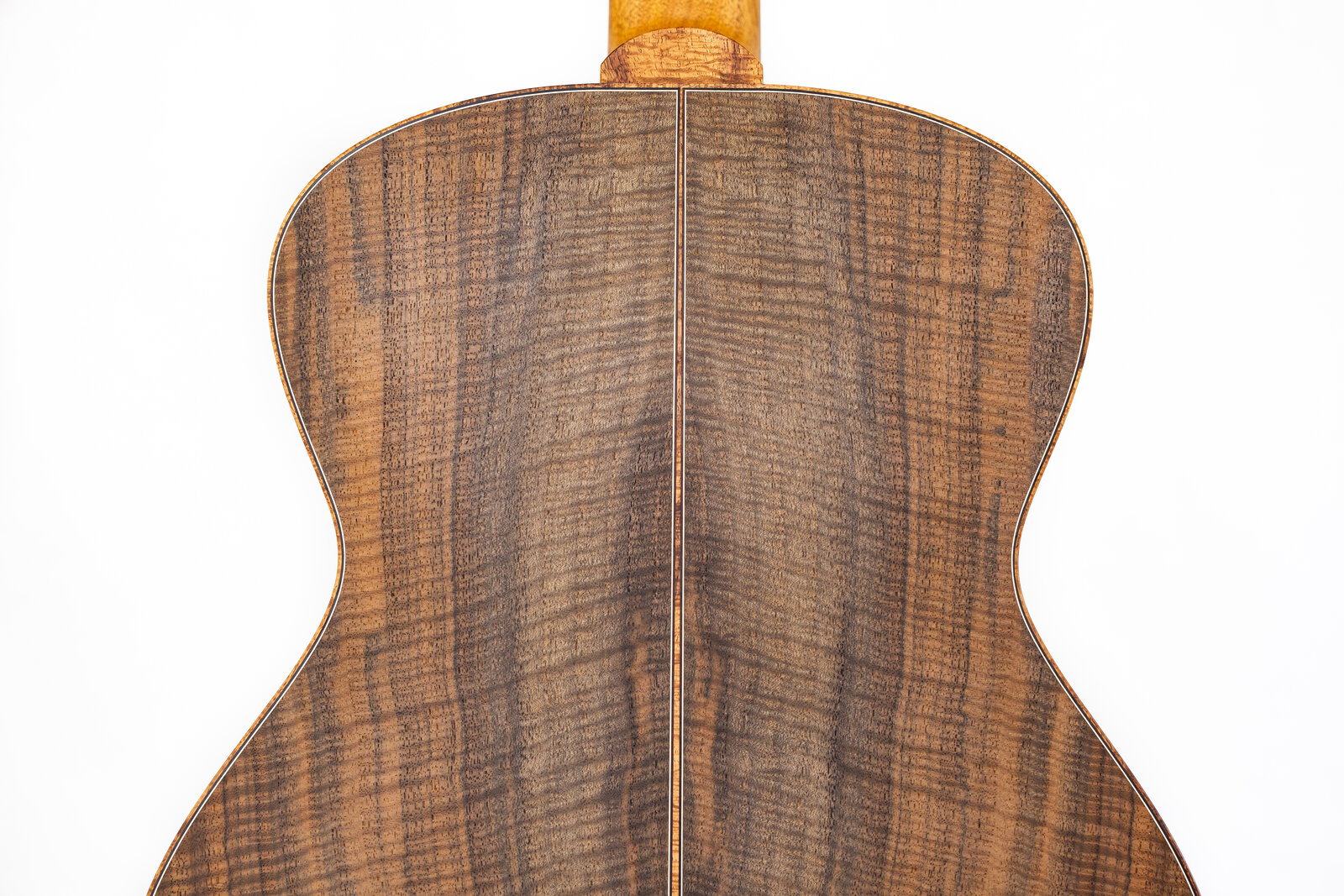 …and what it became. (Photo: The North American Guitar)
Ryan suggested a Manzer Wedge design: basically, the treble side of the body is slightly less deep than the bass side (~8 mm), giving the guitar a slight “wedge” shape if you look at it from the tail end. It’s barely visible, but it makes the guitar more comfortable to play. We also added Ryan’s custom and very subtle armrest bevel, which also helps when playing longer since the arm does not rest on a sharp edge. The way he’s executed this is just incredible: it’s very subtle and uses beautifully figured Koa. We did not include a “soundport”, which is effectively a second soundhole on the guitar’s side. The idea is that it projects a similar sound to the player as the audience hears. Ryan discouraged it, and I gladly followed his advice.
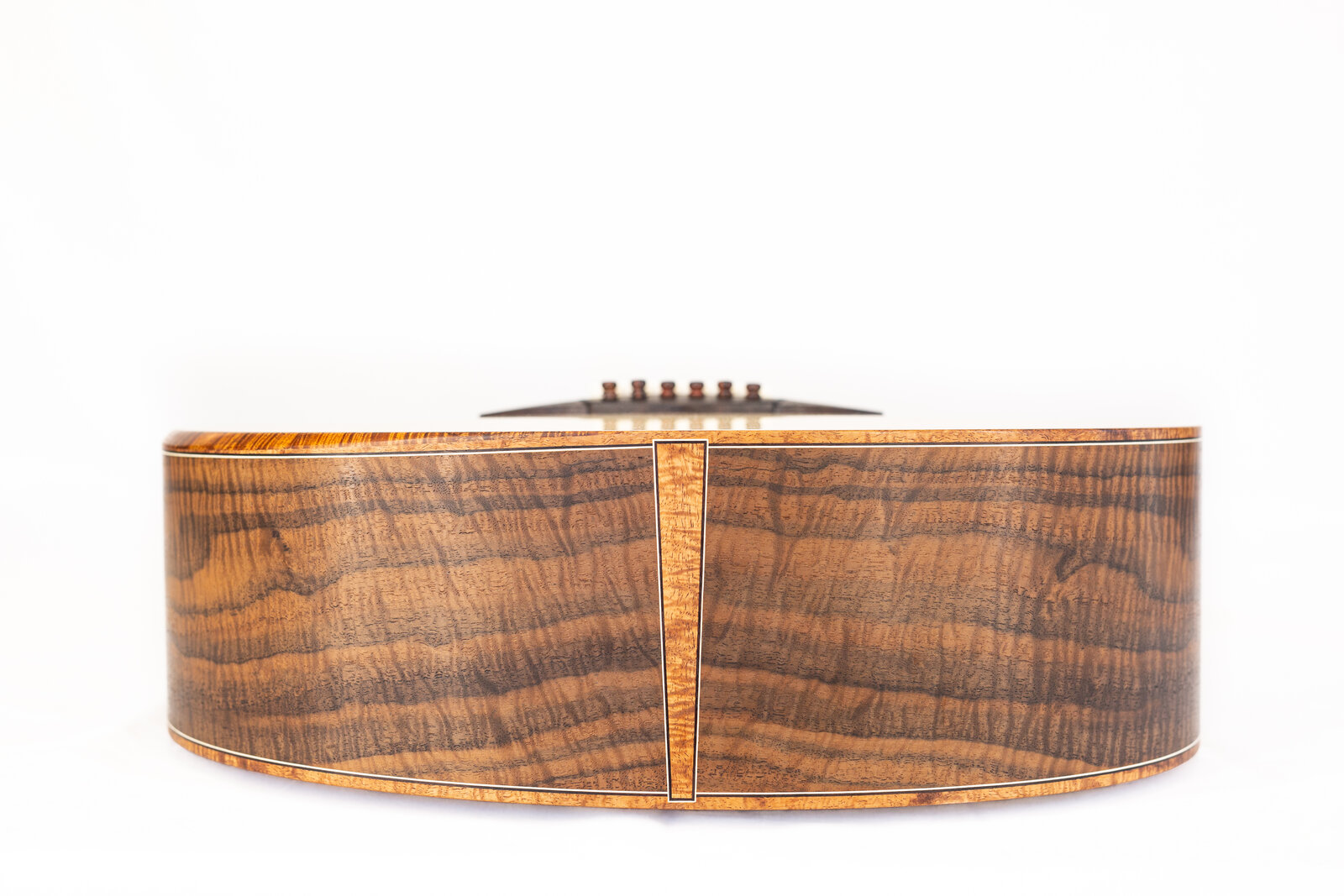 Seen from the tail end: the subtle Manzer wedge — the bass side (left) is ~8 mm deeper than the treble side. (Photo: The North American Guitar)
One thing I was particular about was the finish of the guitar. I did not want the typical high-gloss finish. While it looks shiny in the shops, I don’t actually like the looks and touch of it very much. I prefer a more natural touch to the guitar, which I also think ages better. It took some persuasion since he had never done it before, but in the end I convinced Ryan to try a simple satin finish. It’s basically just the pores of the wood getting filled but otherwise the guitar looks almost natural. One of the nice side effects is that the guitar itself is much lighter: there’s just less material on the guitar, both on the top and on the back. Thick finishes can easily reach 0.5 mm thickness. That’s a lot of material on the top of a guitar that’s been very carefully slimmed and tuned by the luthier. I think it makes the guitar even more responsive. A few years later, I heard Ryan talk about it in a podcast for The North American Guitar, saying that this was one of the surprises for him as well. So I’m kind of proud that there’s a teeny tiny contribution I made here that maybe added to his amazing repertoire.
The second part was harder: the visual design element of the guitar. Here’s what I wanted. First, I wanted to represent where my eldest daughter was born, which is Barcelona. Second, I wanted to represent her heritage from my side, which is from the north of Germany, close to the Danish border. I was born in Schleswig, which was once a Viking settlement. And third, I wanted to represent her French heritage from the south of France, in the Occitanie region, which is where her mother was born. But how? Together with Ryan, we did several different iterations, and he has been incredibly patient and inspiring, coming up with ideas on how to make it real.
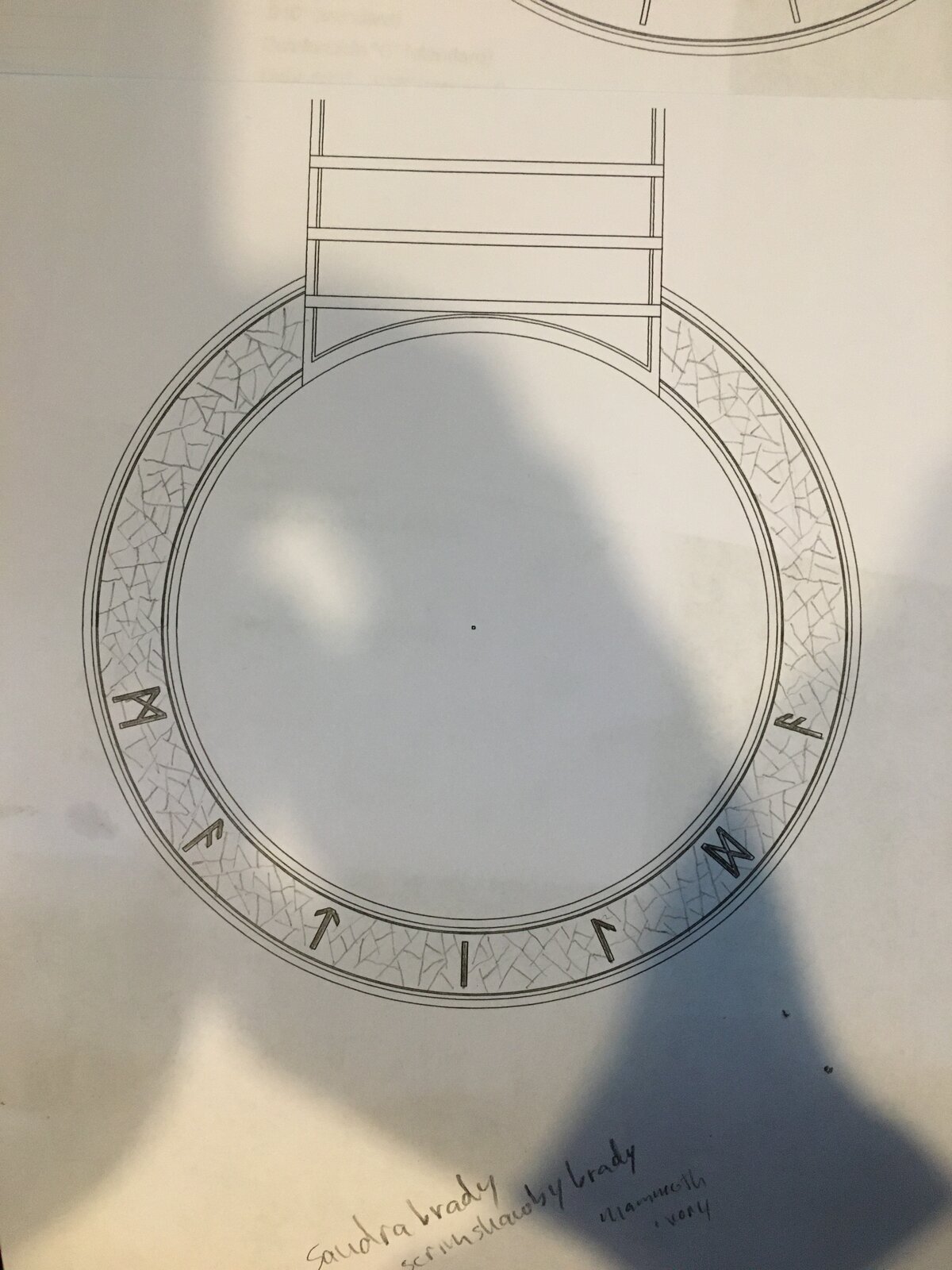 One of Ryan’s pencil drafts for the rosette.
In the end, here’s what we settled on. For the north, we created her name in Viking runes on the rosette. Second, we used mammoth fossil ivory to create a mosaic on the rosette itself, which resembles the typical trencadís mosaics of Gaudí that you can see, for example, in Park Güell in Barcelona. And then third, we embedded the Occitan cross, the emblem of the Occitanie region, into the back of the headstock. Ryan posted photos of the rosette in the making and of the final result on Instagram.
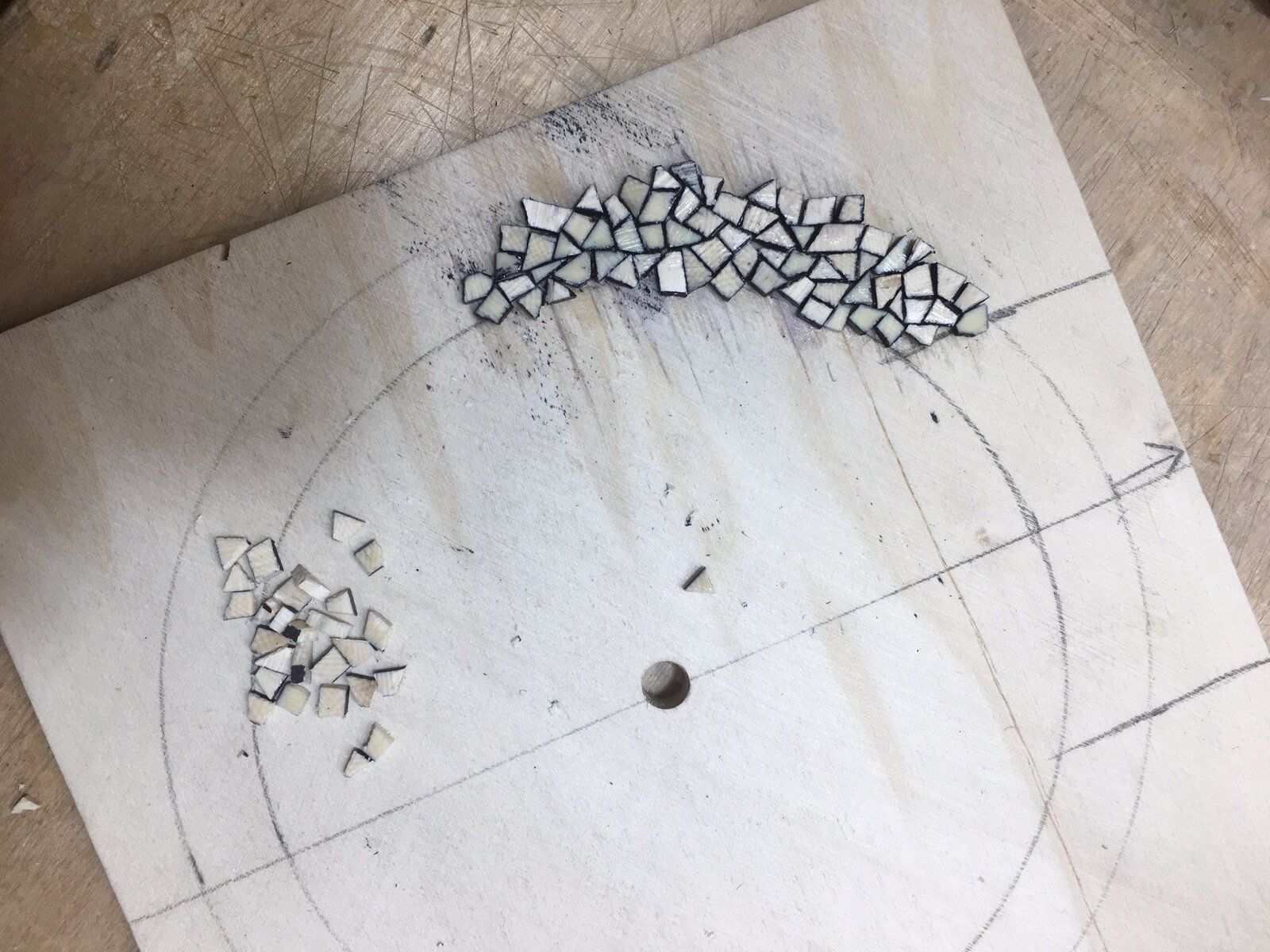 The mammoth-ivory mosaic taking shape, one tiny tile at a time.
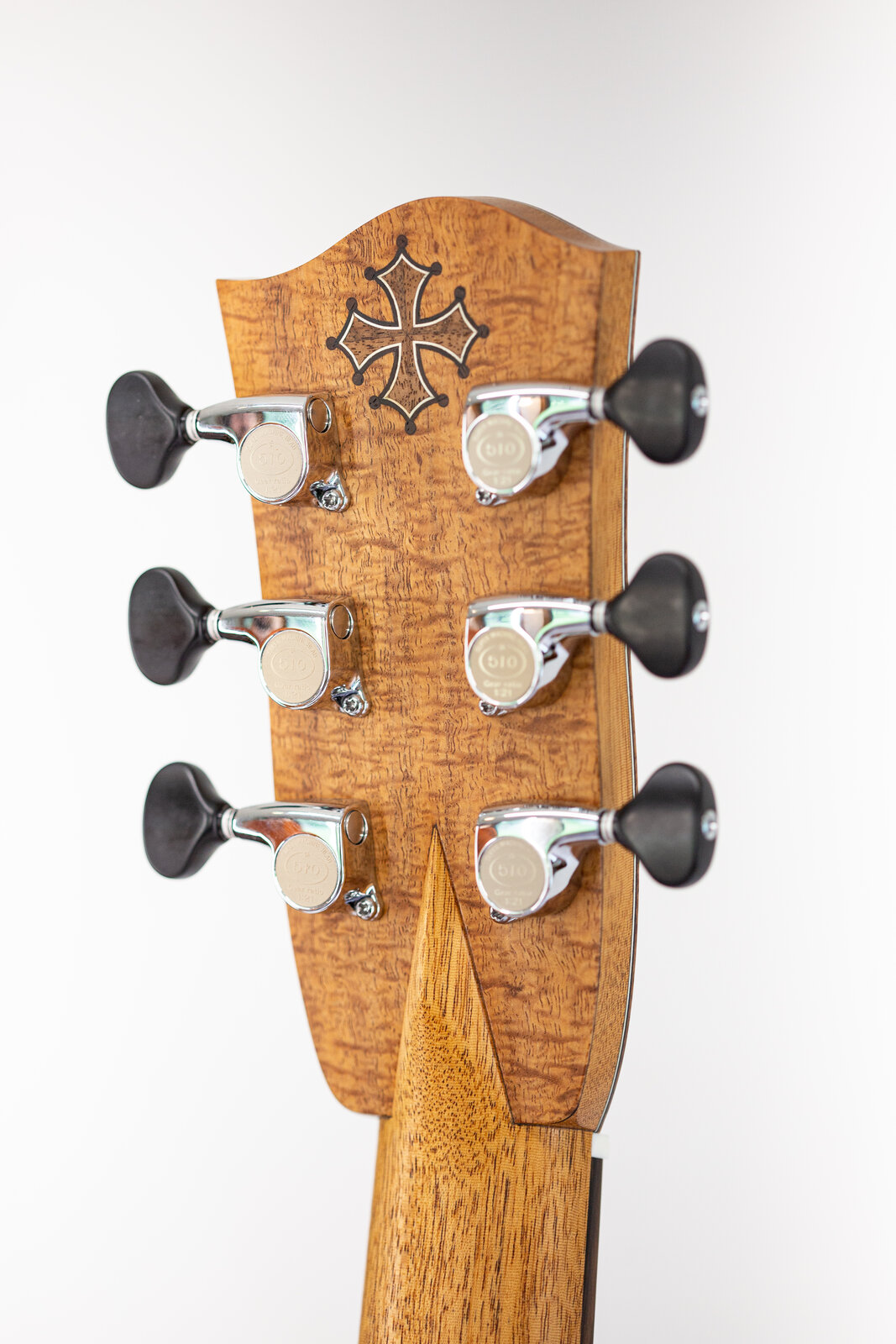 The Occitan cross on the back of the headstock. Note the “bird’s beak” joint at the bottom, where the headstock meets the neck.
I couldn’t be happier with the end result. Not only does it look stunning, it is also subtle and understated. It just looks good first — and then there’s a story behind it I know about. But it doesn’t jump in your face. In fact, it was Ryan who mildly discouraged me from some of the flashier ideas I had originally, and I am very thankful for it. Always trust the masters of their craft. For example, I thought it might be nice to add the famous dragon from Park Güell somehow into the design. So Ryan patiently drew some designs for the rosette, and he even made some little carvings of this dragon for that purpose. But it ended up being too complicated, too busy, and too flashy to really fit the otherwise so beautifully understated guitar design. However, Ryan amazingly did include that little dragon, but on the inside of the guitar body. It was a complete surprise to me and one of the best Easter eggs I’ve ever found. I just love that he included that little detail on the guitar.
With all the details set, the build was ordered and Ryan set off to work. Or rather, he set off to craft, because what he’s built is just plain amazing. It’s hard for me to fathom just how much care and detail he puts into these guitars. Some of the photos show it, but it is even better in reality. For example, the Occitan cross on the back of the headstock. It almost looks fake, as if somebody printed it on. But it is set in wood in pristine, perfect detail. The same goes for the “bird’s beak” joint connecting the headstock to the neck. I also absolutely love how much care Ryan puts into the inside of his guitars. He shared a few photos of the inside of my guitar during the build process on Instagram. Even the insides of his guitars look stunning.
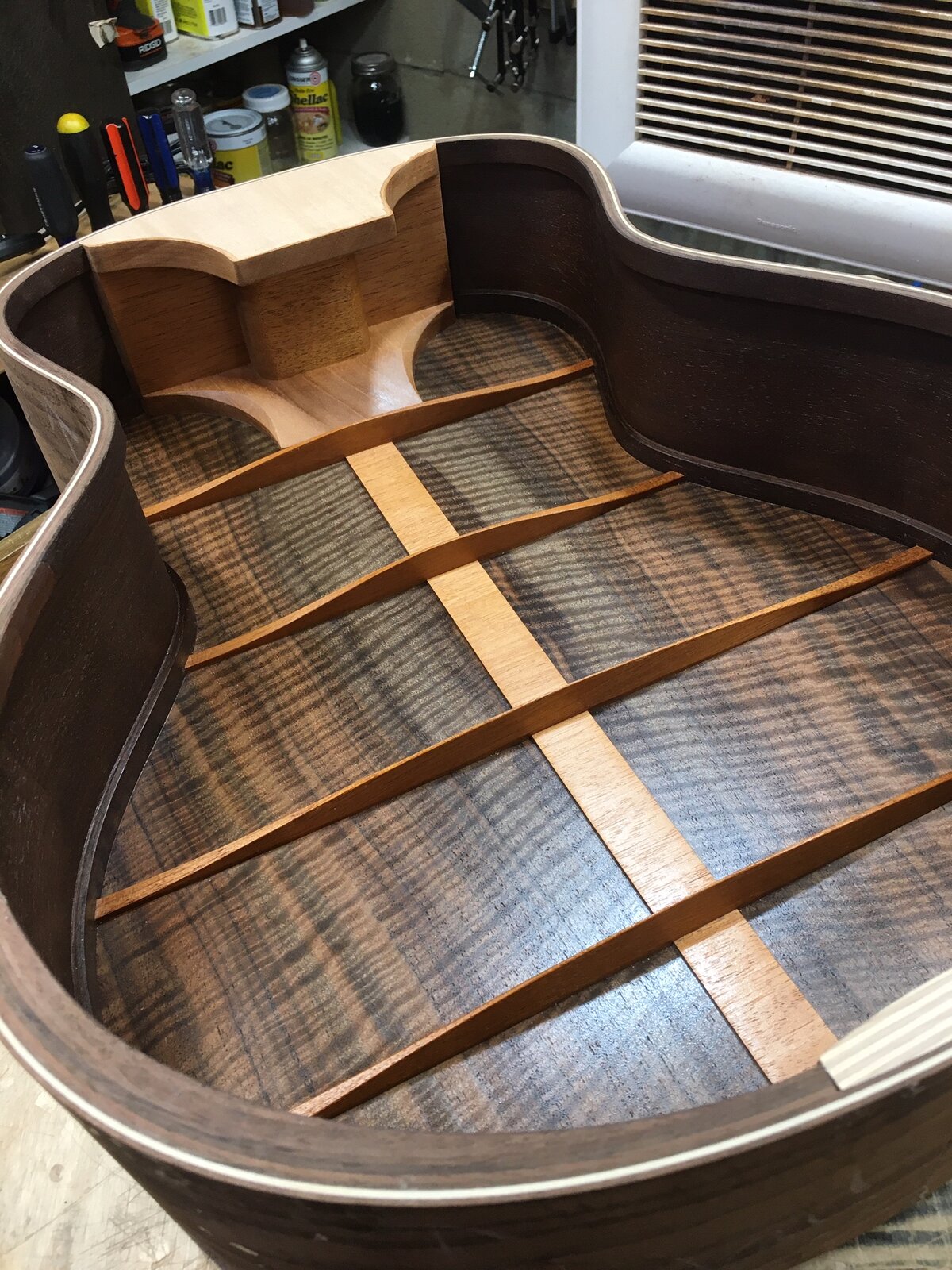 The “luxury designer flat”, still under construction.
Looks are one thing, but in the end, if a guitar doesn’t sound and play great, you’re not really gonna fall in love with it. And boy am I happy with this guitar. It sounds fantastic. It is by far the most responsive guitar I’ve ever owned or played. It almost feels like you just have to look and breathe at it and it starts to hum and sing. It has a very clear tone without being harsh or bright, and it is very even across the whole range from the bass to the top end, without overbearing mids or the inverse, i.e., very shallow mids at the expense of an almost loudness-style, bass- and treble-heavy sound. In short, it’s just an incredibly well-balanced and responsive guitar that is also very, very comfortable to play. The setup, the Manzer wedge, the bevel, the wider neck… all of it combines into a guitar that feels and handles perfectly for me. But don’t take my word for it: luckily, Stuart Ryan demoed my exact guitar on YouTube for The North American Guitar (Ryan also posted a walk-around of the finished guitar). So you can take a look at the two videos and listen to the sound yourself.2
A build like this is a once-in-a-lifetime thing. It was worth it, for me at least, and I cannot recommend Ryan Gerber highly enough. I received the guitar in June 2020. The initially almost-white spruce top has aged beautifully, and it now has a warm, almost honey-like color. It still sounds as amazing as on day one, if not better. I will most certainly keep this guitar until the day I die. The nice thing about acoustic guitars is that they age beautifully, they don’t lose value (unless you abuse them), and they are beautiful objects to behold even if you don’t play.
Well, at least, that’s one of the weaker excuses I tell myself whenever I want to buy a new guitar…
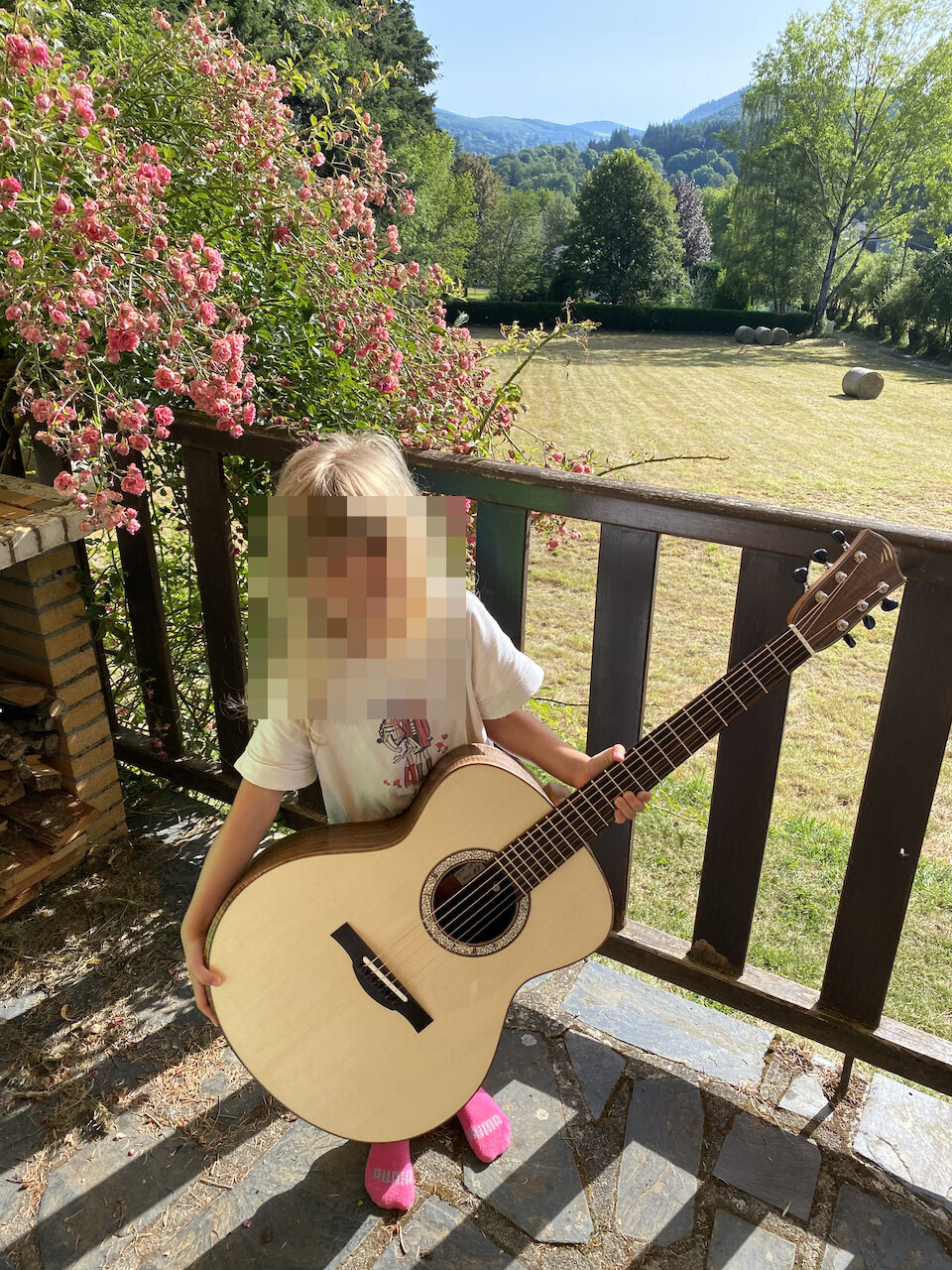 Matilda with her guitar.
For the gear nerds, the full spec, straight from the spec sheet:
- Model: Gerber RL15.5 (#57 - 2020)
- Top: master-grade Swiss moon spruce, ultra-thin satin polyurethane finish
- Back & sides: Claro walnut, pore-filled satin finish
- Neck: Honduran mahogany with bird’s beak headstock joint
- Fretboard: Macassar ebony with color variation
- Bridge: rosewood; bone nut, saddle, and bridge pins
- Scale length: 25.25", 14 frets to the body
- Nut width: 46 mm (custom)
- Ergonomics: Manzer wedge, bevel armrest, no cutaway
- Hardware: Gotoh 510 Delta 21:1 tuners, Evo Gold frets, Schaller S-Locks
- Pickup: K&K Trinity Pro with external preamp
- Case: Visesnut Active Series3
Disclosure: I wrote this post; Claude Code helped with formatting and proofreading.
Legend has it that moon wood is “wood that, according to tradition, exhibits outstanding and unique characteristics when felled during a certain phases of the moon.” I doubt it, but it’s a good story for sure and it’s great wood regardless. ↩︎
I wish I had some great recordings of myself playing the guitar. But neither am I remotely as good as Stuart Ryan nor have I made the time to even try to record something well. I’d rather leave you imagining I sound like Stuart. ↩︎
I could write an entire blog post just on this case. It’s the best guitar case I’ve ever had. Very light, very sturdy, great to carry. ↩︎