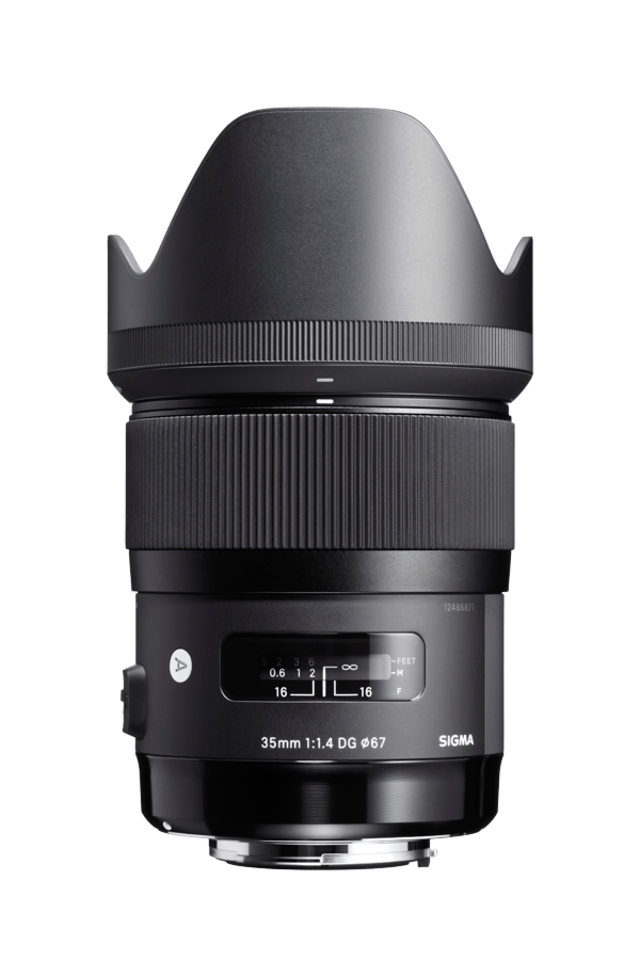
Sigma 35mm f/1.4 DG HSM Art
Added:
Specifications
| Brand | Sigma |
|---|---|
| Category | Wide Angle |
| Prime or Zoom | Prime |
| Focus Type | Auto |
| Focal length (mm) | 35 |
| Aperture (max) | 1.4 |
| Angle of View | 63° |
| Filter Size (mm) | 67 |
| Weight (g) | 755 |
| Length (mm) | 118 |
| Diameter (mm) | 77 |
| Weather Sealed | ✘ |
| Image Stabilization | ✘ |
| Min. focus distance (m) | 0.3 |
| Max. magnification | 0.19 |
| Release Year | 2019 |
| Release Price (USD) | 899 |
Description and Reviews
Key Take-Aways:
The wide-angle prime that opened Sigma’s Art line in DSLR days, now also offered in L-Mount. Professional reviews praise high sharpness at f/1.4, quick quiet autofocus and good value, while vignetting wide open and the absence of weather seals draw criticism; some reviews find soft corners wide open and one finds inconsistent autofocus. Owner sentiment as of Oct 28 2026 is mixed: one shop reviewer calls it very sharp in low light with good colour, while a forum owner’s first copy lost autofocus and back-focused after three months.
From Sigma:
Sigma has always leveraged the most advanced optical technologies to offer photographers the highest level of lens performance. Now, Sigma is proud to offer the first lens in an all-new product line: the 35mm F1.4 DG HSM. This wide-angle F1.4 lens delivers the highest level of brightness and beautiful bokeh effects. It offers the unique characteristics that only a large-aperture F1.4 lens can offer: shallow depth of field along with superior low-light and hand-held performance.
Several types of optical aberration can affect the image quality of a lens. Chromatic aberration is among the most important, and minimizing it is essential. There are two types of chromatic aberration: transverse, which can be corrected for with digital processing; and axial, which is difficult to minimize after a shot is taken. In the 35mm F1.4 DG HSM, FLD (“F” Low Dispersion) glass, which is equivalent to fluorite in its characteristics, and SLD (Special Low Dispersion) glass help optimize the power distribution of the lens. This optimization minimizes axial chromatic aberration by causing the different wavelengths of light to strike the same focus position while also minimizing transverse chromatic aberration. In addition, aspheric lenses help minimize astigmatism and field curvature. Thanks to these features, resolution is extremely high from the center to the edges of the photograph.
The aspheric lens at the front of the lens series helps minimize both distortion and vignetting. The rounded diaphragm produces an attractive round bokeh effect at large-aperture settings. Optimized power distribution minimizes sagittal coma flare. Coma of point light sources near the edge of the image and axial chromatic aberration are both minimized, making the lens an excellent choice for photographing nighttime landscapes and heavenly bodies.
When photographing with point light sources such as electric lights or reflections on a body of water in the background, the rounded 9-blade diaphragm helps produce an attractive bokeh effect—even at large-aperture settings.
Sigma has discontinued this lens. It is the predecessor of sigma-35mm-f1-4 (the Sigma 35mm f/1.4 DG DN Art): the DG HSM is a DSLR design that Sigma also offered in L-Mount, which is why it is large and heavy. Specifications are the L-Mount figures from Sigma’s English page (angle of view 63.4 degrees entered as 63, maximum magnification 1:5.2 entered as 0.19). Sigma America no longer lists an L-Mount selection, so the price is the regular price of the L-Mount selection on Sigma America’s own page as archived on 8 Nov 2021 (web.archive.org/web/20211108143603/https://www.sigmaphoto.com/35mm-f14-dg-hsm-a), where $849 was a sale price; the 2020 and early 2021 archive copies show the same L-Mount option. Dustin Abbott’s and Christopher Frost’s Sony E videos and several other videos cover other mounts of the same lens.
Reviews:
- Photography Blog: Sigma 35mm F1.4 DG HSM Review, Mark Goldstein, Jan 2013
- Imaging Resource: Sigma 35mm f/1.4 DG HSM Art Review, Andrew Alexander, Jan 2013
- Cameralabs: Sigma 35mm f1.4 Art review, Thomas, Feb 2013
- Photography Life: Sigma 35mm f/1.4 DG HSM Art Review, Nasim Mansurov, Jul 2013
- Photo Review: Sigma 35mm f/1.4 DG HSM Art Lens, Apr 2014
- Dustin Abbott: Sigma 35mm f/1.4 DG HSM Art Review, Jan 2016
- Digital Camera World: Sigma 35mm f/1.4 DG HSM | A review, Jon Stapley, Jul 2019
YouTube:
- Christopher Frost: Sigma 35mm f/1.4 DG HSM ‘Art’ Lens review (APS-C & full frame, with samples), Nov 2013
- Camera & Lens Review: Sigma 18-35 and Sigma 35 Art Comparison | Blackmagic 4K, May 2015
- Chris Winter: Sigma 35mm 1.4 Art Lens In-Depth Review & Video Test, Jul 2015
- Dustin Abbott: Sigma 35mm f/1.4 DG HSM ART Review - in a Snowstorm!, Jan 2016
- Josh Luciano: SIGMA 85mm 1.4 & 35mm 1.4 Art Series Lens Review, Mar 2017
- Spencer Lupul: my short review of the Sigma 35mm f/ 1.4 Art, Nov 2018
- Dirksón! Photography: Sigma 35mm f1.4 ART long term REVIEW in 2019 - still the best 35mm lens? REUPLOAD, May 2019
- Tin House Studio: Sigma 35mm f1.4 Art lens review + sample images, Nov 2019
- Bach Photography: Sigma 35mm F1.4 ART Full Review and Photoshoot 1 Year Later [RAW files], Mar 2020
- Kensei Akatsu: Sigma 35mm F/1.4 DG HSM Art on Sony A7III | THE CITY PHOTOGRAPHY BEAST, Mar 2020
- JEBYxD: Sigma 35mm f1.4 Art Lens Review: Is it Worth $699 & Fixing the Focus Issue with Canon Cameras, May 2020
- Christopher Frost: Sigma 35mm f/1.4 ‘Art’ on Sony E-mount: high resolution test (and re-review), Jul 2020
- Alex McInnes: SIGMA 35mm ART f/1.4 Lens Review - IS IT ANY GOOD for CAR PHOTOGRAPHY?, Aug 2020
- Colton Simmons: Is the SIGMA ART 35MM 1.4 for NIKON still viable in 2025?? [Sigma Art 35mm Lens Review], Feb 2021
- CARLO OBRIEN: SIGMA 35mm 1.4 VS SIGMA 24mm 1.4, Feb 2021
- Dustin Harrelson: Bad Auto Focus?? | Sigma 35mm f/1.4 DG HSM ART Review, Aug 2021
- Luke Cleland: Sad to say GOODBYE to my Sigma Art Lenses after 3 years., Feb 2023
- Patrick Berger: The ONLY PRIME LENS you need? Sigma 35mm F1.4 Art Lens Review, Oct 2024
- Mirth Films: Sigma 35mm f/1.4 Art DG HSM Lens Review, Nov 2024